Reviewed by the emergency care team at Aether Health ER | Spring Cypress, Kingwood, and SilverLake (Pearland), TX | +1 (713) 528-8703
| ✓ YES, YOU CAN
No appointment, no referral, no advance notice required. Every emergency room in the United States is required by federal law to screen anyone who walks through the door, regardless of insurance, ability to pay, or immigration status. Here’s what to expect when you do. |
Can I just show up to the emergency room? Yes, absolutely. ERs are built for unplanned, urgent visits. You don’t need an appointment, a referral, or advance notice. You simply walk in, check in at registration, and get triaged.
That said, a few things help. Knowing what to bring, what to expect, and when a walk-in is the right choice (versus calling 911) makes the whole process smoother and often faster.
The Short Answer
Yes. You can walk into any emergency room without an appointment or prior notice. The law requires every ER to provide a medical screening exam to anyone who requests one. For non-life-threatening but urgent issues, a freestanding ER is often the faster choice.
At Aether Health ER, our three Greater Houston locations are open 24/7 for walk-ins, with no appointment needed and board-certified physicians on-site.
Why the Law Requires ERs to See You

A federal law called EMTALA (Emergency Medical Treatm ent and Labor Act), passed in 1986, requires every ER that accepts Medicare (nearly all of them) to provide: ¹
- A medical screening exam to every person who requests one
- Stabilizing treatment for any emergency medical condition identified
- Appropriate transfer if the facility can’t handle the case
All three apply regardless of your insurance status, ability to pay, or citizenship. No ER can turn you away at the door for financial or administrative reasons. This is why walking in is not just allowed, it’s a legal right.
Before this law existed, some hospitals refused to treat uninsured patients even during life-threatening emergencies. EMTALA closed that gap and continues to protect every patient today, whether the ER is attached to a hospital or operates as a freestanding facility.
What to Bring (and What’s OK to Forget)
Having a few items ready speeds up registration. If you forget everything, the ER still sees you. Here’s the practical breakdown.
| ✓ BRING THIS | ○ DON’T STRESS IF YOU FORGET |
| Photo ID (driver’s license, passport, etc.) | Cash or payment: billing happens later |
| Insurance card (physical or on your phone) | Medical records: we can request from providers |
| List of current medications and doses | Imaging CDs: the ER has its own |
| List of known allergies | Change of clothes: not usually needed |
| Your primary care doctor’s name and number | Food: nothing to eat before evaluation anyway |
| A family member or friend if possible | Paperwork: all intake happens on-site |
Not sure if your situation is ER-appropriate or something urgent care can handle? Contact our team and we can help you decide where to go.
What Happens the Moment You Walk In
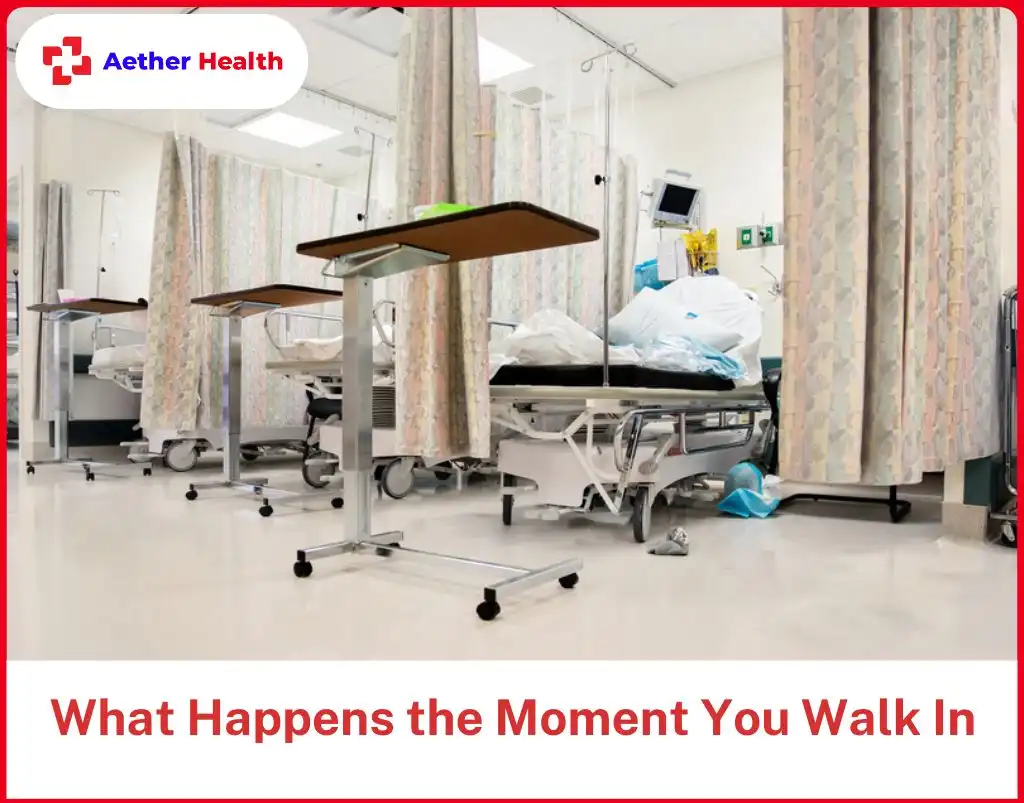
The walk-in process looks similar at most ERs, though freestanding ERs are typically faster because they handle a smaller case mix. Here’s what to expect at any Aether Health location.
Step 1: Registration (2 to 5 minutes)
A receptionist asks your name, reason for visit, and insurance information. If you don’t have insurance, you’re still registered. Billing conversations happen later.
Step 2: Triage (5 to 10 minutes)
A nurse checks your vital signs (temperature, blood pressure, pulse, oxygen) and asks about your symptoms. This determines how quickly you’re seen. Chest pain and breathing difficulty move to the front of the line.
Step 3: Room Assignment
At a freestanding ER, you’re usually in a room within minutes. At a hospital ER, this can take longer during busy periods. You change into a gown if needed.
Step 4: Physician Evaluation
A board-certified emergency physician examines you, orders labs or imaging if needed, and begins forming a diagnosis. From here, the clock depends on the complexity of your case.
For most freestanding ER visits, the first four steps complete within 15 minutes of walking through the door, which is why many patients choose this route over hospital ERs for non-life-threatening but urgent problems.
When Walk-In Is Smart vs. When to Call 911 First
Walking in works for most urgent situations. Certain emergencies, however, need an ambulance. Aether Health’s no-wait ER model covers the full range of urgent-but-not-life-threatening conditions.
Walk In Yourself When You Have:
- Deep cuts, splinters, or wounds
- High fever, severe flu, or dehydration
- Abdominal pain without severe symptoms
- Broken bones, sprains, or sports injuries
- Allergic reactions without breathing difficulty
- Migraines, ear infections, or sinus pain
- Urinary tract infection symptoms
- Minor burns or minor eye injuries
Call 911 Instead For:
- Chest pain lasting more than a few minutes
- Stroke symptoms (facial drooping, slurred speech, arm weakness)
- Difficulty breathing or choking
- Severe bleeding that won’t stop
- Loss of consciousness
- Seizures
- Signs of anaphylaxis
- Head trauma with confusion or vomiting
| Never try to drive yourself during a possible heart attack or stroke. Paramedics can start life-saving care en route and communicate directly with the ER before you arrive, saving critical minutes. |
Do You Need Insurance to Walk In?
No. You don’t need insurance to be seen in an emergency room. MedlinePlus (NIH) and federal law both confirm that emergency medical treatment cannot be denied based on insurance status or ability to pay.²
How Billing Works Without Insurance
- No upfront payment required: You’re treated the same as an insured patient during the visit
- Billing comes later: You receive an itemized bill after the visit
- Financial assistance available: Most ERs, including Aether Health, offer financial assistance applications and payment plans
- Self-pay rates: Freestanding ERs commonly provide transparent, no-surprise-billing pricing when you ask
The important thing to remember: being uninsured or underinsured is never a reason to delay emergency care. Delaying care can turn a treatable condition into a medical emergency.
Can They Turn You Away?
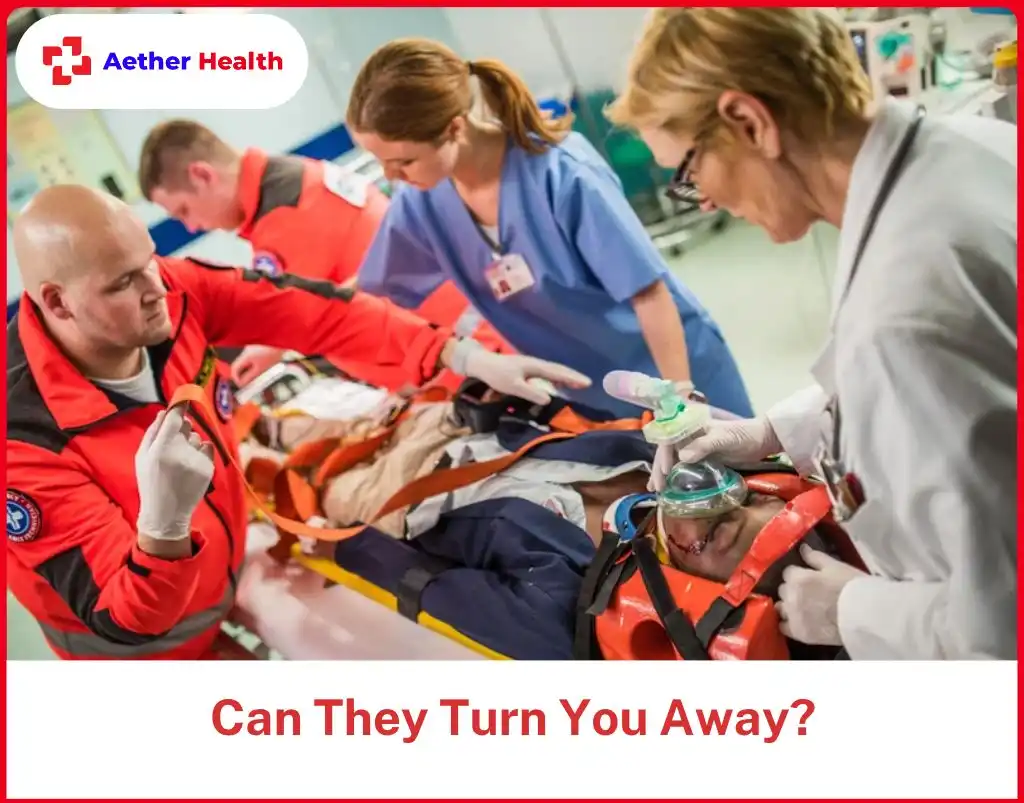
No, not before screening you. By federal law, every ER must provide a medical screening and stabilizing treatment for any emergency condition. Aether Health’s freestanding ER model operates under the same EMTALA protections as hospital ERs.
Situations Where You May Be Transferred (Not Turned Away)
- Specialty care: Your condition requires a specialist who isn’t on-site
- Admission needed: You need inpatient admission at a hospital with available beds
- Pediatric specialty: Pediatric emergencies may transfer to a children’s hospital
- Trauma level: Severe trauma may transfer to a Level I trauma center
In all these cases, the ER stabilizes you first, then arranges transfer. You’re never discharged home with an untreated emergency.
Common Questions About Walking Into the ER
Do I need to tell the ER I’m coming?
No. ERs don’t take reservations. You can walk in any time, 24/7. Some ERs offer an online check-in to reduce wait time, but it’s optional, not required for care.
What if the ER is full when I show up?
You’ll still be seen. ERs legally cannot turn you away. During busy times, less-urgent cases wait in the triage area. A freestanding ER is a good alternative if hospital ER waits are long.
Can I bring my child to the ER without their other parent?
Yes. Either parent or legal guardian can authorize emergency care. For truly life-threatening emergencies, ERs can treat a child even without a guardian present under the implied consent doctrine.
Do ERs see undocumented patients?
Yes. EMTALA applies to every patient regardless of immigration status. ERs are not immigration enforcement, and most do not routinely ask about citizenship as part of the medical visit.
What if I arrive by taxi, rideshare, or by walking?
You’re seen the same as anyone else. Mode of arrival doesn’t affect triage or care. If you’re in distress, tell the receptionist immediately so they can expedite your triage.
Need Care Today? Just Walk In
Aether Health ER welcomes walk-ins 24/7 across three Greater Houston locations. No appointment, no referral, no insurance required to be seen.
Call +1 (713) 528-8703 or walk into Spring Cypress, Kingwood, or SilverLake (Pearland). Open every day of the year.