
Reviewed by the emergency care team at Aether Health ER | Spring Cypress, Kingwood, and SilverLake (Pearland), TX | +1 (713) 528-8703
| 4h 20m
Average U.S. hospital ER stay |
< 1 hour
Typical freestanding ER door-to-doctor |
24+ hours
Observation stay maximum |
How long can a person stay in the emergency room? The honest answer: anywhere from 30 minutes to 24 hours or longer, depending on the severity of the problem, the facility you choose, and whether you need admission or observation.
Hospital ERs often hold patients for hours because of triage priority, imaging bottlenecks, and bed availability. Freestanding ERs usually move patients through far faster for comparable complaints.
The Short Answer
A typical emergency room visit lasts between 2 and 6 hours. According to CDC data, the average U.S. hospital ER stay is around 4 hours and 20 minutes from arrival to discharge. Minor issues can resolve in under an hour. Complex cases requiring admission or observation can extend to 24 hours or more.¹
Freestanding ERs often dramatically shorten this because they handle a more selective caseload and bypass the hospital boarding bottleneck.
Average ER Stay Times by Scenario

Not every ER visit takes the same amount of time. Here’s what to expect based on what brought you in.
| Scenario | Hospital ER | Freestanding ER | Common Reason |
| Minor issue (small cut, ear infection) | 2 to 4 hours | 30 to 90 minutes | Triage and quick diagnosis |
| Moderate (abdominal pain, fever, mild injury) | 4 to 6 hours | 1 to 2 hours | Labs, imaging, observation |
| Complex (chest pain, severe injury, stroke evaluation) | 6 to 12 hours | 2 to 4 hours (with transfer if needed) | Full diagnostic workup |
| Admission needed | 8 to 24+ hours | Transfer within 2 to 4 hours | Waiting for an inpatient bed |
| Observation stay | Up to 24+ hours | Coordinated transfer if extended | Ongoing monitoring |
5 Factors That Decide How Long You’ll Be There
Your stay length depends on far more than the problem you came in with. These five factors shape the clock from the moment you walk in, whether you’re visiting a hospital ER or using Aether Health’s adult emergency services.
- Triage priority: Life-threatening cases jump the line. Non-emergent complaints wait longer, especially at hospital ERs.
- Diagnostic workload: Blood work, urine tests, and imaging each add 20 to 60 minutes. CT scans and ultrasounds can extend stays significantly.
- Boarding and bed availability: Hospital ERs can hold admitted patients for hours waiting for an inpatient bed (called “boarding”). Freestanding ERs don’t face this bottleneck.
- Time of day and season: Nights, weekends, and flu season all increase average wait times.
- Specialist consultation: If a cardiologist, orthopedic surgeon, or neurologist needs to weigh in, stays grow accordingly.
The 4 Phases of an ER Visit
Every emergency room visit moves through four phases. Understanding them helps set realistic expectations and clarifies where time is spent. Guidance from the American College of Emergency Physicians aligns with this general flow.²
Phase 1: Triage (5 to 15 minutes)
A nurse or physician assesses vital signs and the severity of your complaint. Higher-acuity cases are seen first. Freestanding ERs usually complete triage within minutes of arrival.
Phase 2: Evaluation (30 to 90 minutes)
A physician examines you, orders labs and imaging, and begins forming a diagnosis. This is where hospital ERs often slow down because imaging queues can be long.
Phase 3: Treatment (30 minutes to several hours)
IV care, pain management, wound closure, or other interventions happen. Treatment time depends on the complexity of your issue.
Phase 4: Disposition (30 minutes to several hours)
The physician decides whether you’re discharged, admitted, transferred, or kept for observation. For admitted patients, waiting for a bed is where many hospital ER stays stretch past 12 hours.
Hospital ER vs. Freestanding ER: Why Wait Times Differ
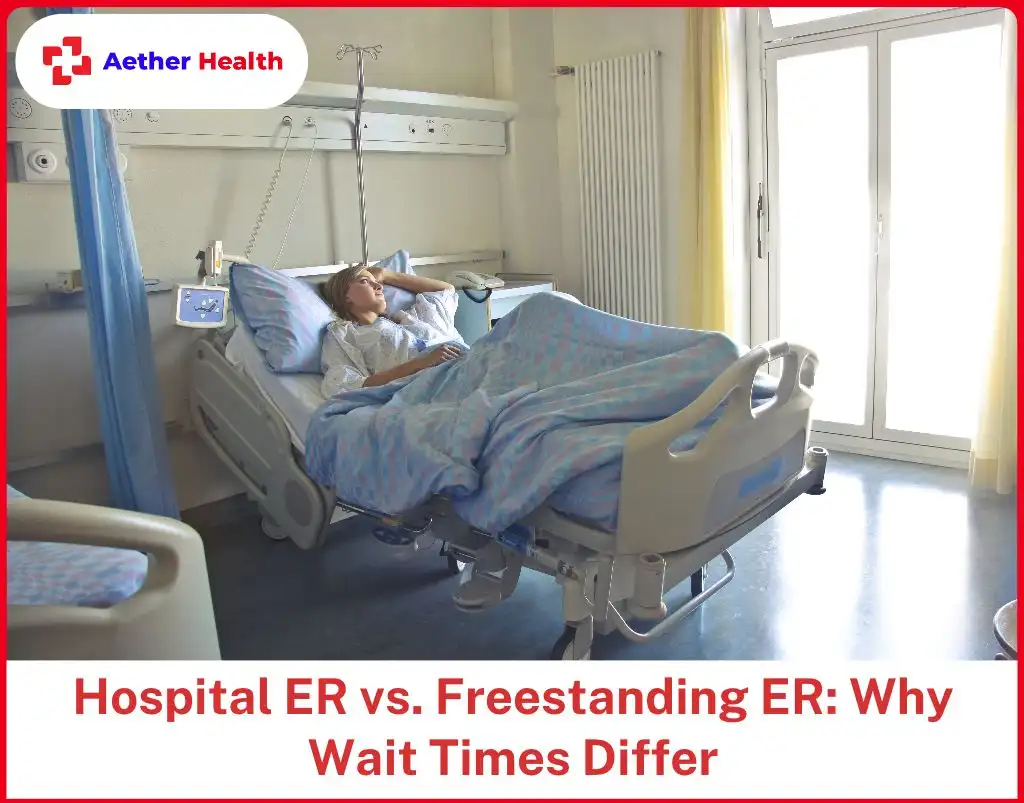
The structural difference between hospital and freestanding emergency rooms directly shapes how long you’ll stay. Here’s how Aether Health’s no-wait ER model delivers faster care.
| Feature | Hospital ER | Freestanding ER |
| Door-to-doctor time | 1 to 3 hours | Often under 30 minutes |
| Case mix | All severity levels mixed | Mostly non-life-threatening emergencies |
| Boarding bottleneck | Common | Not an issue |
| On-site services | Full, but queued | Same-visit labs, imaging, EKG |
When the ER Will Keep You Longer: Observation Stays
Sometimes you’re not sick enough for admission but not well enough for discharge. In those cases, the ER keeps you under observation. Aether Health’s freestanding ER model coordinates transfer to a hospital partner when extended observation is clinically needed.
Common Reasons for an Observation Stay
- Chest pain with normal initial testing but ongoing concern
- Dehydration requiring extended IV fluids
- Head injury needing a repeat neurological check
- Possible stroke or TIA under monitoring
- Severe allergic reaction after initial treatment
- Elderly patients with falls or confusion
Observation stays typically last 6 to 24 hours. They’re billed differently from full admissions and don’t always count as “inpatient” status.
Can You Leave the ER Against Medical Advice?

Yes, legally you can leave the emergency room at any time, as long as you’re mentally competent. This is called leaving Against Medical Advice (AMA). You can’t be physically detained, but there are real consequences to walking out before care is complete. At Aether Health, our team will clearly explain the risks before you sign out.
What You Should Know About AMA
- You’ll be asked to sign a form acknowledging the risks.
- Some insurance plans may refuse to pay for an AMA visit (though this is less common now).
- Symptoms that led you to the ER may worsen without completed care.
- Minors cannot be signed out AMA without a parent or legal guardian.
- If staff believe you’re not mentally competent to leave, a psychiatric evaluation may be ordered first.
| Never leave the ER against medical advice for a life-threatening symptom. Chest pain, stroke symptoms, severe bleeding, or breathing difficulty should not wait. If frustrated by a long hospital ER wait, consider transferring to a freestanding ER instead of leaving. |
Common Questions About ER Stay Times
What is the longest you should stay in an ER?
Most patients should be seen by a physician within 1 hour and have a disposition within 6 hours. Hospital ER stays over 12 hours usually indicate an admission is pending but no inpatient bed is available.
Why do hospital ERs take so long?
The main bottleneck is boarding: admitted patients occupy ER beds while waiting for hospital rooms. Mixed-acuity triage, imaging queues, and specialist consultations also add hours compared to freestanding ERs.
Will a freestanding ER see me faster for chest pain?
Yes, often within minutes. Freestanding ERs have on-site EKG, cardiac markers, and continuous monitoring. Same-visit cardiac workups are standard, with transfer coordination if admission becomes necessary.
Can I be discharged from the ER at night?
Yes. ERs discharge patients 24 hours a day. There’s no restriction on time of day for discharge. Your transportation home is your responsibility unless mobility or medical issues require special arrangement.
Does bringing someone with me speed things up?
A companion doesn’t directly shorten your stay, but they can help communicate symptoms, ask questions, remember instructions, and advocate if you’re too unwell to speak clearly for yourself.
Need Faster Care? Walk Into Aether Health ER
Aether Health ER provides same-visit evaluation, labs, imaging, and physician care across three Greater Houston locations. Open 24/7, no appointment needed. For questions, contact our team or call +1 (713) 528-8703.