

Migraines rarely arrive out of nowhere. Hours or even a full day before the head pain begins, your body often sends quiet warning signals: mood shifts, food cravings, neck stiffness, or a sudden yawn you can’t explain. Then, for about a third of people, a visual “aura” appears: shimmering zigzags, blind spots, flashing lights. Recognizing these first signs of a migraine can give you a window to act before the worst pain hits.
This guide walks through the four phases of a migraine attack, what each early sign looks and feels like, how to tell a migraine apart from something more serious like a stroke, and when your symptoms warrant migraine emergency care at Aether Health ER.
Quick Answer: What Are the First Signs of a Migraine?
The first signs of a migraine typically appear 24 to 48 hours before the headache itself, during a phase called the prodrome. Common early signs include mood changes (irritability, depression, or euphoria), food cravings, unusual thirst, frequent yawning, neck stiffness, fatigue, difficulty concentrating, and increased sensitivity to light or sound.
About one in three people also experience an aura: visual disturbances like zigzag lines, blind spots, or flashing lights, usually lasting 20 to 60 minutes before the headache begins. Recognizing these early signs helps you act before the pain becomes severe.
The 4 Phases of a Migraine at a Glance
Migraines aren’t just headaches. They unfold in a predictable pattern with up to four phases, though not every person experiences every phase. One should be well aware of what causes migraine and this reference table maps what to expect and when.
| Phase | When It Happens | Duration | Key Signs |
| Prodrome | 24–48 hours before headache | Hours to a full day | Mood changes, cravings, yawning, neck stiffness, fatigue |
| Aura | Just before or at headache onset | 20–60 minutes | Visual disturbances, tingling, speech changes (in about 1 in 3) |
| Headache | Peak of the attack | 4–72 hours | Throbbing pain, nausea, light and sound sensitivity |
| Postdrome | After the headache resolves | Up to 24 hours | Fatigue, confusion, mood dips, mild residual pain |
The prodrome and aura phases are the earliest signs. Learning to spot them gives you the widest window to rest, hydrate, and get to a quiet environment before the pain phase hits.
Prodrome: The Earliest Warning Signs (24–48 Hours Before)
The prodrome phase is when the brain begins signaling that a migraine is coming, often before you consciously notice anything is wrong. Roughly 60% of people who get migraines experience prodrome symptoms. The signals are subtle and easy to miss until you learn to look for them.
Common Prodrome Signs
- Mood changes: Sudden irritability, depression, anxiety, or an unusual burst of energy or euphoria.
- Food cravings: Sudden craving for chocolate, salty snacks, or specific comfort foods.
- Increased thirst: Excessive thirst or noticing you’re drinking far more water than usual.
- Frequent yawning: Repeated, uncontrollable yawning that seems out of context.
- Neck stiffness: Tightness or aching at the base of the skull, sometimes mistaken for a tension headache.
- Fatigue: Feeling drained or unusually tired despite adequate sleep.
- Concentration problems: Difficulty finding words, brain fog, or trouble focusing on simple tasks.
- Sensory sensitivity: Sounds seem louder, lights seem brighter, or smells feel overwhelming.
- Digestive changes: Constipation or diarrhea, sometimes days before the headache.
- Sleep disturbances: Regularly waking up feeling like a migraine is on its way.
| Track your patterns: If you notice the same combination of signs before every migraine, you have a personal early-warning system. Keeping a migraine diary that logs mood, food intake, sleep, and stress can help you spot your prodrome pattern within a few attacks. |
Aura: Visual and Sensory Symptoms (20–60 Minutes Before Pain)

Aura affects roughly one in three people who get migraines. It’s a wave of neurological activity that produces short-lived visual, sensory, or speech disturbances. Aura symptoms typically last between 5 and 60 minutes and either overlap with or immediately precede the headache phase.
Visual Aura Signs
- Zigzag lines: Wavy, jagged lines drifting across your visual field, often called a scintillating scotoma.
- Flashing lights: Flickering, sparkling, or shimmering lights in your peripheral vision.
- Blind spots: A growing dark spot that expands across part of your visual field.
- Tunnel vision: Vision narrows as if you’re looking through a tube.
- Kaleidoscope patterns: Geometric or fractured patterns overlaying your vision.
- Temporary vision loss: Rarely, complete or partial vision loss lasting under an hour.
Sensory Aura Signs
- Tingling or numbness: Pins and needles that start in one hand and slowly spread up the arm to the face.
- One-sided weakness: Weakness or heaviness on one side of the body (in rare hemiplegic migraines).
- Speech difficulty: Trouble finding words, slurred speech, or difficulty understanding others briefly.
- Auditory changes: A ringing sound or brief hearing changes.
| Important: Aura symptoms can look identical to signs of a stroke or transient ischemic attack (TIA), especially for someone experiencing them for the first time. If you have a new-onset aura, an aura that lasts longer than 60 minutes, an aura on only one side that includes weakness, or an aura with slurred speech or facial drooping, treat it as a stroke and go to the ER immediately. |
The Headache Phase: What a Full Migraine Feels Like
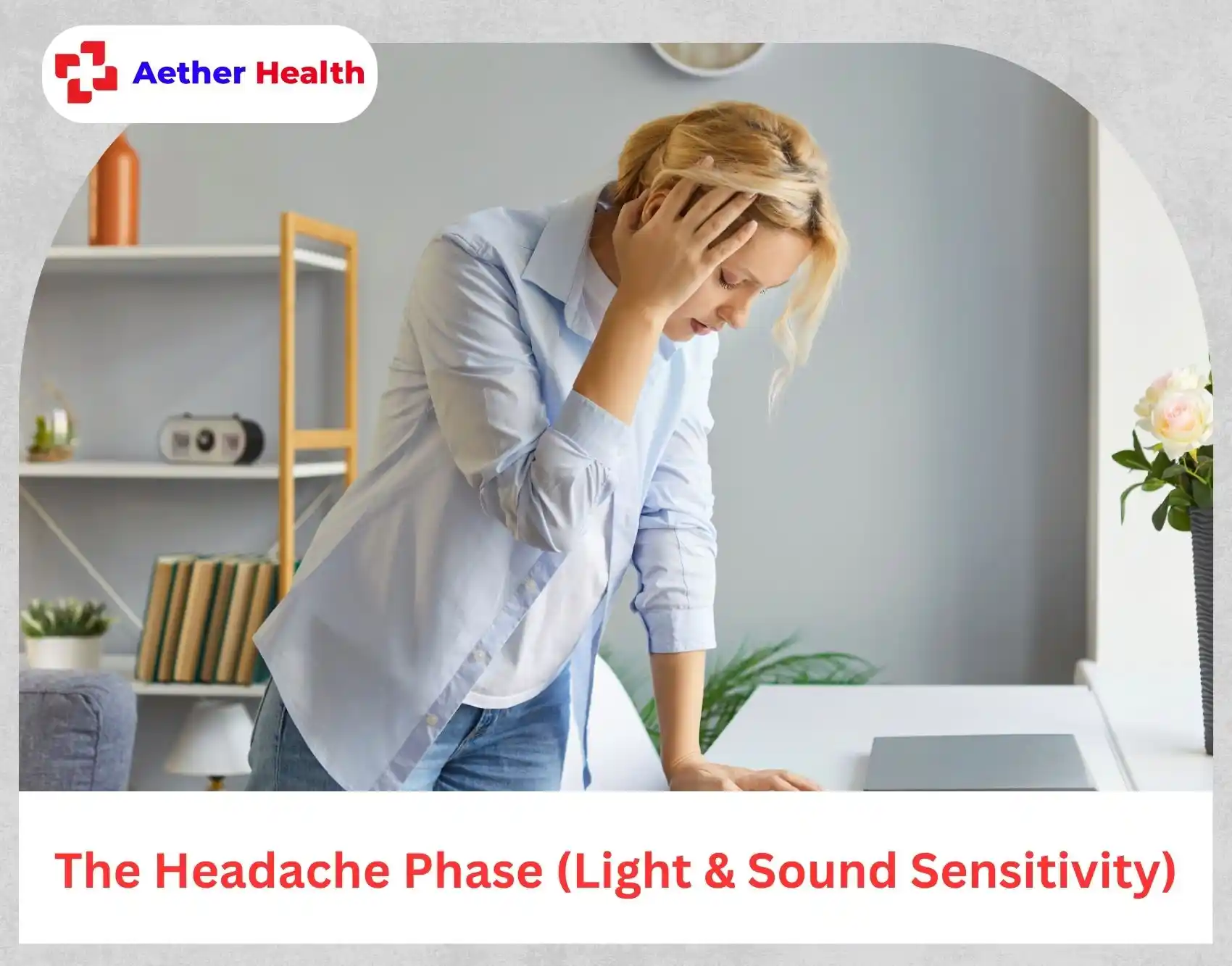
Once the pain phase begins, the migraine is in full force. Understanding what this phase feels like helps you differentiate a true migraine from a tension headache, sinus headache, or something more serious.
Common Headache Phase Symptoms
- Throbbing pain: Deep, pulsating pain that intensifies with movement, most often on one side of the head.
- Light sensitivity (photophobia): Ordinary light feels painfully bright, driving people to darkened rooms.
- Sound sensitivity (phonophobia): Normal conversation or background noise becomes unbearable.
- Smell sensitivity (osmophobia): Perfumes, cooking odors, or gasoline fumes can trigger a wave of pain.
- Nausea and vomiting: Stomach upset that can become severe.
- Dizziness or vertigo: Feeling off-balance or the room seeming to move.
- Brain fog: Difficulty thinking, forming sentences, or completing tasks.
- Skin changes: Pale, clammy skin or facial flushing.
Migraine headaches typically last 4 to 72 hours if untreated. Pain often builds gradually over 30 to 60 minutes, peaks for several hours, then slowly recedes.
Postdrome: The “Migraine Hangover”
The postdrome is the final phase, often called the migraine hangover. It kicks in after the headache resolves and can last up to 24 hours. Most people feel drained, mentally slow, and emotionally flat during this phase.
Common Postdrome Signs
- Physical fatigue that resembles recovery from the flu.
- Difficulty concentrating or brain fog that lingers.
- Low mood or emotional sensitivity.
- Mild residual pain when you move your head suddenly.
- Slight nausea or lack of appetite.
- Muscle soreness, especially in the neck and shoulders.
- Feeling elated or euphoric (in some people).
The postdrome isn’t dangerous, but if fatigue is severe or you can’t return to normal function within 24 hours after a migraine resolves, that’s a reason to be evaluated. In rare cases, prolonged postdrome symptoms can signal a status migrainosus (a migraine lasting over 72 hours) that needs medical attention.
Migraine vs. Stroke: How to Tell the Difference

This is one of the most important sections for anyone with a new or unusual migraine. Migraine symptoms can mimic those of a stroke, and even seasoned migraine sufferers occasionally have trouble telling them apart. Use this comparison to guide your decision.
| Feature | Migraine | Stroke or TIA |
| Onset | Gradual (minutes to build) | Sudden (seconds to peak) |
| Aura duration | 5–60 minutes, then resolves | Longer than 60 minutes or worsening |
| Weakness | Very rare, part of hemiplegic aura | Common, sudden, one-sided |
| Speech changes | Rare and brief | Common, slurred or garbled |
| Facial drooping | Not typical | Common warning sign |
| Headache | Usually follows aura | May be sudden and severe (worst ever) |
| Past history | Similar attacks before | Often no history of similar events |
The BE FAST rule helps identify a stroke quickly: Balance loss, Eyes (vision changes), Face drooping, Arm weakness, Speech difficulty, Time to call 911. Any of these signs mean you should treat the event as a stroke first and let the ER team determine whether it’s actually a migraine.
When a Migraine Requires Emergency Care
Most migraines are painful and disruptive but not dangerous. However, certain patterns cross the line into emergency territory. Get to the ER right away if you experience any of these.
Go to the ER Immediately If You Have:
- Sudden severe headache described as “the worst headache of my life”
- Headache with facial drooping, arm weakness, or slurred speech
- Sudden vision loss or double vision
- Aura symptoms lasting longer than 60 minutes
- First-time migraine after age 50
- Headache following a head injury or fall
- Migraine with fever, stiff neck, or rash
- Headache with confusion, memory loss, or personality changes
- A migraine that lasts longer than 72 hours (status migrainosus)
- Severe vomiting that prevents you from keeping fluids down
- Migraine that feels different from your usual pattern
- Pregnancy with severe headache and elevated blood pressure
- Headache with seizures or loss of consciousness
| Get evaluated fast: Aether Health ER provides 24/7 migraine emergency care with continuous monitoring, on-site CT imaging, labs, and board-certified emergency physicians who can differentiate a migraine from stroke, brain bleed, or meningitis within minutes. Call +1 (713) 528-8703 or walk into any of our three Greater Houston locations. |
How Aether Health ER Evaluates Migraine Emergencies
When you walk in with a severe or unusual migraine, our team is equipped to identify or rule out serious neurological conditions quickly and provide the workup you need. Here’s what to expect from Aether Health ER 24/7 migraine emergency care:
- Rapid triage: Board-certified emergency physicians assess neurological status, vital signs, and symptom patterns within minutes of arrival.
- Neurological exam: Focused stroke and neurological assessments to rule out life-threatening causes of severe headache.
- On-site CT scan and labs to identify or rule out stroke, brain bleed, meningitis, and other serious causes of severe headache.
- Continuous monitoring: Real-time monitoring of blood pressure, heart rhythm, and oxygen saturation throughout your visit.
- IV support: IV access for hydration and rapid delivery of care when needed for prolonged migraine or severe vomiting.
- Direct hospital transfer when admission is needed, coordinated by our team. Learn more about our freestanding ER model and how it compares to hospital ERs.
- Transparent pricing: Most commercial plans accepted. No surprise billing. No balance billing. Transparent care.
Three 24/7 Greater Houston locations, all reachable at +1 (713) 528-8703:
- Aether Health Spring Cypress ER: 8929 Spring Cypress Rd, Spring, TX 77379
- Aether Health Kingwood ER: 2158 Northpark Dr, Kingwood, TX 77339
- Aether Health SilverLake ER: 2752 Sunrise Blvd, Pearland, TX 77584
Frequently Asked Questions
How long before a migraine do the first signs appear?
Prodrome signs can appear 24 to 48 hours before the headache. Aura signs, if you get them, typically appear 5 to 60 minutes before the pain begins. Recognizing your personal pattern gives you the widest window to rest and prepare.
What is the very first sign of a migraine?
For most people, the earliest sign is a subtle mood or energy shift: irritability, unusual fatigue, food cravings, or repeated yawning. These prodrome signs are easy to miss until you learn to track your migraine patterns.
Can migraines start without a headache?
Yes. Silent migraines, also called acephalgic migraines, produce aura and other symptoms without the headache phase. These are especially confusing because visual disturbances or numbness can mimic stroke symptoms. First-time silent migraines should always be evaluated in an ER.
What triggers the first signs of a migraine?
Common triggers include stress, hormonal changes, poor sleep, skipped meals, dehydration, alcohol, specific foods (aged cheese, cured meats, artificial sweeteners), bright lights, strong smells, and weather changes. Trigger patterns are highly individual.
Should I go to the ER for a migraine?
Most migraines can be managed at home. Go to a freestanding ER like Aether Health if you have the worst headache of your life, migraine with weakness or speech changes, first-time migraine after 50, migraine after a head injury, or a migraine lasting longer than 72 hours.
How do I tell a migraine aura from a stroke?
Migraine aura builds gradually over minutes and resolves within 60 minutes. Stroke symptoms appear suddenly, often within seconds, and typically include one-sided weakness, facial drooping, or slurred speech. When in doubt, treat it as a stroke and call 911.
People Also Ask About the First Signs of a Migraine
These are the related questions AI search engines and Google’s People Also Ask feature commonly surface alongside first-signs-of-migraine queries. Direct answers below.
What is the prodrome phase of a migraine?
The prodrome is the earliest migraine phase, occurring 24 to 48 hours before the headache. Common signs include mood changes, food cravings, yawning, neck stiffness, and fatigue. About 60% of people who get migraines notice prodrome symptoms if they know what to look for.
Can migraines cause blurry vision as an early sign?
Yes. Blurry vision, blind spots, zigzag lines, or flashing lights are classic aura symptoms that can appear 5 to 60 minutes before the migraine headache. These visual disturbances usually affect both eyes and resolve completely as the aura phase ends.
Do migraines start on one side of the head?
Often, yes. Roughly 60% of migraines begin on one side of the head, though pain can spread or switch sides during the attack. Bilateral migraines (both sides) are also common, especially in chronic migraine patterns.
What does the beginning of a migraine feel like?
The very beginning often feels like a subtle sense that something is off: heaviness in the head, mild neck tightness, unusual mood or energy, or a mild ache building at one temple. Aura may follow with visual or sensory changes.
Can dehydration trigger the first signs of a migraine?
Yes. Dehydration is one of the most common and preventable migraine triggers, especially in Texas heat. Even mild dehydration can trigger the prodrome phase within hours. Consistent hydration is one of the most effective at-home prevention strategies.
How often do migraines have warning signs?
About 60% of migraine sufferers experience prodrome signs, and about 33% experience aura. Some people have both, some have neither. Tracking your own patterns over several attacks reveals your personal warning system.
Severe or Unusual Migraine? Get Evaluated Now.
When a migraine feels different, lasts longer than usual, comes with weakness or speech changes, or hits without warning after age 50, it needs an ER visit. Aether Health ER provides 24/7 migraine emergency care with continuous monitoring, on-site CT imaging, board-certified emergency physicians, and the ability to rule out stroke or brain bleed within minutes.
- Locations: Three 24/7 locations across Greater Houston
- Spring Cypress — 8929 Spring Cypress Rd, Spring, TX 77379
- Kingwood — 2158 Northpark Dr, Kingwood, TX 77339
- SilverLake — 2752 Sunrise Blvd, Pearland, TX 77584
- Phone: +1 (713) 528-8703
- Hours: Open 24 hours, every day of the year
- Insurance: Most commercial plans accepted. No surprise billing.
- Contact: Get in touch with our team for questions or directions.