Noticing a dark red or purple blister in your mouth can be a shocking experience, especially when it develops overnight and doesn’t cause you any pain. Most people immediately think it an infection, cancer or blood disorders, but’s that’s not the case usually.
Something like that should hurt but you didn’t feel the pain. Is it normal or are painful days just around the corner?
In fact, most painless blood blisters in the mouth are harmless and tend to resolve on their own, associated with a minor injury or fragile blood vessels, even if you don’t remember having injured yourself.
What Is a Blood Blister in Mouth?
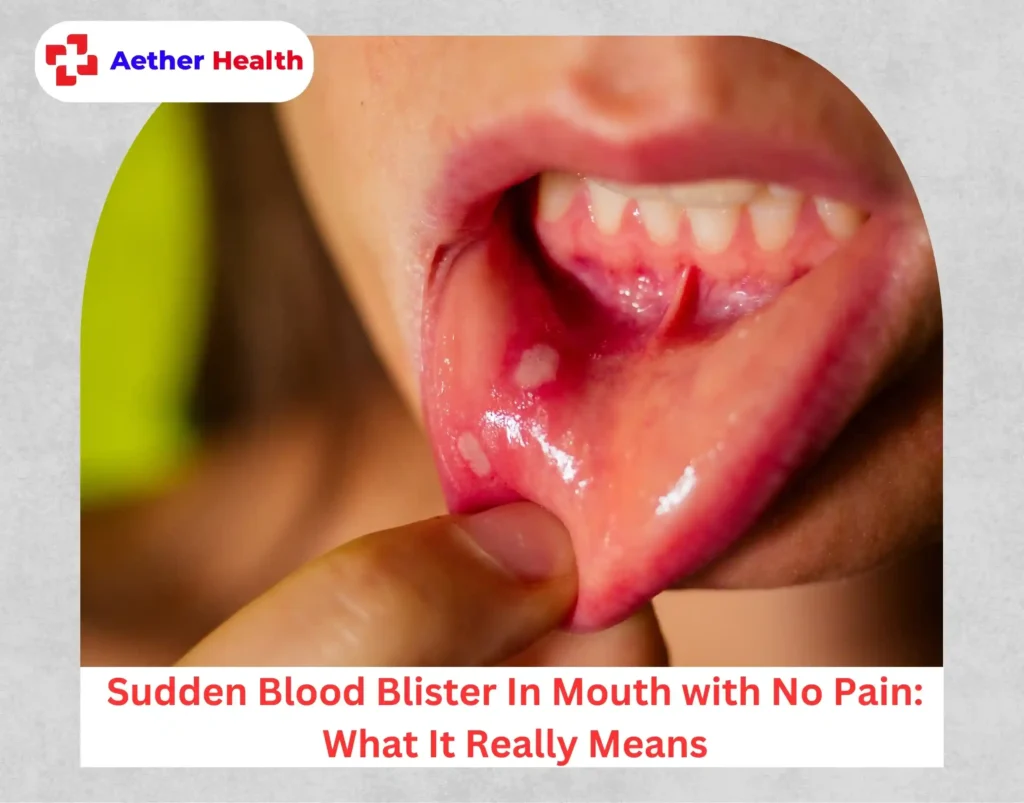
A blood blister is a tiny pouch filled with blood that has formed on the oral lining (mucosa). It is different from canker sores, or ulcers as with this the skin does not break. A blister develops when small blood vessels tear open and bleed into nearby tissue.
Blood blisters most often formed in:
- The inner cheeks.
- The lips.
- The tongue.
- The soft palate.
- The floor of the mouth.
They generally look dark red, purple or bluish; feel soft or be slightly raised; and can appear dramatic when in fact they’re not that serious.
You should also keep in mind that the blood blister is not an infected area. It’s a mechanical or vascular phenomenon, not caused by bacteria or virus.
Why You May Develop a Blood Blister Out of Nowhere & Without Any Pain

Some of the common causes as to why these painless blisters would suddenly emerge are:
Accidental Trauma (Most Common Cause)
Even if you can’t recall biting your cheek or lip, trauma is the top cause of oral blood blisters.
Triggers include:
- Cheek or tongue biting while eating or during sleep.
- Hard or crunchy foods (chips, nuts, toast).
- Food that is too hot, creating an instantaneous burden on the tissue.
Dental Work or Aggressive Brushing
The pressure from these accidents can burst tiny blood vessels beneath the skin, creating a painless blister filled with bloody fluid.
Angina Bullosa Hemorrhagica (ABH)
This is possibly the most commonly misdiagnosed yet crucial cause of sudden, pain-free oral blood blisters.
Angina bullosa hemorrhagica (ABH) is a benign disorder characterized by the sudden eruption of blood filled blisters in the oral cavity, commonly:
- Without pain.
- Without trauma.
- Without underlying disease.
Key features include:
- Sudden onset.
- Dark red or purple blister.
- Commonly on the soft palate.
- Turbulent or resolves spontaneously in a few days.
- No scarring.
Although it has a scary title, ABH is unrelated to heart disease and the condition itself is quite benign.
Dental Appliances and Oral Irritation
Dentures, braces or use of a retainer that does not fit properly and ill-fitting dental work can rub against sensitive oral tissue, causing irritation on small blood vessels.
Repeated even minor friction may lead to:
- Blood blisters.
- Localized swelling.
- No pain initially.
- Fragile Blood Vessels.
As people age, blood vessels are more fragile. This increases the risk of mucosal-to-submucosal spontaneous bleeding, even with slight pressure.
This can occur:
- During chewing.
- While yawning.
- From temperature changes in food.
- Allergic or Chemical Irritation.
Some mouthwashes or toothpaste components, or acidic foods, can irritate the oral lining sufficiently to debilitate capillaries so that blood seeps under unbroken tissue.
How Can You Differentiate Between Blood Blister in Mouth Vs Other Mouth Lesions
Here’s how they are different:
Blood Blister
- Dark red or purple.
- Fluid-filled with blood.
- Skin intact.
- Usually painless.
- Heals in days to a week.
Canker Sore (Aphthous Ulcer)
- With the red border, white or yellow center
- Painful.
- Open ulcer
- Not blood-filled
- Cold Sore (Herpes)
Multiple small blisters
- Tingling or burning before appearance.
- Usually on the lips not in the mouth.
- Persistent.
- Irregular borders.
- May bleed easily.
- Usually painless at first, but don’t go away
Why Some Blood Blisters Do Not Hurt at All
Pain requires nerve stimulation. In the mouth, many places can have:
- Thinner tissue.
- Fewer pain receptors.
- Reduced inflammation is producing injury at the site of application.
A blood blister that forms quickly, doesn’t stretch tissue significantly, doesn’t cause swelling or infection may never trigger pain signals. This is frequently seen with ABH and trauma-induced blisters.
A Simple Self-Assessment Tool You Can Use Today
To avoid panic, consider this rapid assessment:
Location
- Inner cheek, palate, tongue? → More likely benign
- Gumline with tooth pain? → Dental cause possible
Onset
- Sudden and rapid? → Trauma or ABH
- Gradual and persistent? → Needs evaluation
Pain
- No pain or tenderness? → Often harmless
- Increasing pain or burning? → Investigate further
Size and Change
- Can it shrink or explode by itself? → Reassuring
- Growing, recurring, or spreading? → Needs assessment
Duration
- Resolves within 7–10 days? → Normal healing
- Lasts more than 2 weeks? → Get checked
Is It Safe to Pop a Blood Blister in Your Mouth?

It is not safe as Popping a blood blister:
- Increases infection risk.
- Delays healing.
- Can cause unnecessary bleeding.
The majority of oral blood blisters will spontaneously burst or be reabsorbed. Let the body handle it.
Home Care for a Painless Mouth Blood Blister
All you need is a supportive care:
- Rinse gently with warm saltwater.
- Hot, spicy or acidic foods are off the menu.
- Maintain gentle oral hygiene.
- Avoid irritating mouthwashes.
- Let the blister resolve naturally.
- Recovery is generally 3–10 days.
When to See a Doctor or Dentist

You should get evaluated if:
- The blister persists for more than 2 weeks.
- You have recurrent blood blisters.
- The lesion is getting bigger or darker.
- There is unexplained bleeding elsewhere.
- You are having trouble swallowing or speaking.
- Several lesions are developing at the same time.
A critical evaluation helps rule out:
- Blood disorders.
- Vitamin deficiencies.
- Autoimmune conditions.
- Rare oral malignancies.
When ER Evaluation Is the Right Call
Most painless blood blisters in the mouth resolve on their own and don’t require emergency care. However, there are situations where rapid evaluation is the safest next step, especially when symptoms don’t fit the usual benign pattern.
You should consider Aether Health ER if:
- A blood blister appears alongside unexplained bleeding elsewhere.
- You notice sudden swelling of the mouth, tongue, or throat.
- The blister is accompanied by shortness of breath, dizziness, or weakness.
Final Thoughts
A sudden blood blister in the mouth with no pain is usually benign, temporary, and self-resolving. In most cases, it’s caused by minor trauma or fragile blood vessels, even if you don’t remember an injury.
Understanding how these blisters behave allows you to respond calmly rather than fearfully. Monitor it, support healing, and seek evaluation only when clear warning signs appear.
Frequently Asked Questions (FAQs)
2.What causes a blood blister in the mouth without pain?
It’s usually caused by minor, unnoticed trauma like cheek biting, hot or sharp foods, or fragile blood vessels that bleed under intact tissue without irritating nerves.
2.Can blood blisters be painless?
Yes. Many oral blood blisters are painless because they form beneath the surface without inflammation or nerve involvement, especially on the soft palate or inner cheeks.
3.Where is Silver Lake ER located, and Are You Open 24/7?
Silver Lake ER is located at 2752 Sunrise Blvd, Pearland, TX 77584, and is a 24/7 emergency facility providing immediate evaluation and care for urgent medical concerns, day or night.
4.Why did I get a blood blister out of nowhere?
Blood blisters can appear suddenly due to unnoticed pressure, chewing, temperature changes, or spontaneous vessel rupture, even when there’s no obvious injury.
5.What is the treatment of sudden blood blisters in the mouth with no pain?
Most require no treatment and heal on their own within days; gentle oral care and avoiding irritation is usually enough unless the blister persists or recurs.